
Phone Case Materials Compared: TPU, Silicone, PU and TPU + PC
Table of Contents
- What Should a Brand Buyer Check in Material Samples?
- How to Request an Accurate Material Recommendation
- Frequently Asked Questions
- What Is the Best Material for a Phone Case?
- Is TPU Better Than Silicone for Phone Cases?
- Are Silicone Phone Cases Made Only from Silicone?
- Is PU Leather the Same as Genuine Leather?
- What Is a TPU + PC Phone Case?
- Can All Four Material Types Include Magnetic Charging Structures?
- Can Logos and Artwork Be Applied to Every Phone Case Material?
- What Material Information Should Be Written in a Purchase Order?
- Should I Approve a Material Swatch or a Finished Case Sample?
- What Is the MOQ for Custom Phone Case Materials?
- Choose the Right Phone Case Material for Your Brand
The best phone case material is not the same for every brand. TPU can support flexible, highly customizable designs. Silicone can create a soft-touch, color-led product. PU leather can add a business or wallet-style appearance. A TPU + PC structure can combine a flexible frame with a more rigid back or supporting shell.
For sourcing, the important question is not simply “Which material is best?” It is “Which complete structure fits the target price, appearance, protection concept, decoration method and customer group?” Two cases carrying the same material label may feel and perform differently because of thickness, grade, surface treatment, inner structure, corner design and production quality.
This guide compares four common phone case material options for brand and wholesale projects: TPU, silicone, PU leather and TPU + PC. It also explains what to verify before approving a sample or requesting a quotation.
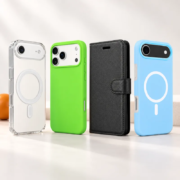
Quick Comparison of Phone Case Materials
| Material / structure | Typical feel | Main sourcing strengths | Points to verify | Good fit for |
|---|---|---|---|---|
| TPU | Flexible; may be clear, colored, glossy, matte or textured | Versatile structures; artwork, logo, color and magnetic options | Grade, clarity, surface, fit, edge thickness and long-term appearance | Broad assortments, printed designs, clear or flexible cases |
| Silicone | Soft-touch, smooth and grippy | Premium hand feel; strong solid-color presentation; magnetic options | Exact construction, lint/dust behavior, coating consistency, lining and fit | Color-led collections, minimalist and soft-touch ranges |
| PU leather | Leather-like grain; soft or structured depending on backing | Business, fashion and wallet styling; embossing and pattern options | Surface grain, edge finishing, fold area, backing and inner holder material | Wallet cases, folios, gift and business-oriented ranges |
| TPU + PC | Flexible edge with a more rigid panel or shell | Defined structure; design zoning; magnetic and multilayer options | Layer bonding, hard-panel scratching, drop geometry, magnet alignment and assembly | Protective, magnetic, transparent-back and feature-led cases |
What Are Phone Cases Made Of?
A finished phone case is often a material system rather than a single material. The outside surface, protective frame, rigid back, lining, magnetic ring, adhesives and decorative layers may all be different. This is why a product name such as “silicone case” or “leather case” should be treated as a starting point, not a complete specification.
For example, a silicone case may use a liquid-silicone exterior with a microfiber lining and an internal supporting structure. A PU leather case may use a PU-coated surface over a backing, then hold the phone in a TPU inner shell. A TPU + PC case deliberately combines a flexible thermoplastic polyurethane component with a rigid polycarbonate component.
When comparing quotations, ask every supplier to identify the materials used in each visible and functional part. Without that information, two products with similar photos can be difficult to compare accurately.
TPU Phone Cases
TPU stands for thermoplastic polyurethane. It is commonly used for flexible phone case bodies, edges and bumpers. Material producers describe TPU as a thermoplastic elastomer that can bridge the gap between hard plastics and rubber-like flexibility. The exact balance of elasticity, hardness, transparency and abrasion behavior depends on the selected grade and construction.
For a brand buyer, TPU is attractive because one material family can support several visual directions. A case may be transparent, translucent, opaque, soft-touch, glossy, printed, glitter-finished or combined with a magnetic ring. Lumei’s current examples include pure TPU artwork cases, clear TPU cases, soft-touch translucent TPU cases and card-display structures.
Why buyers choose TPU
- Flexible edges can make installation and removal easier than with a fully rigid shell.
- The surface can support UV artwork, heat transfer, silk-screen logos and other project-specific decoration methods.
- Stock and custom colors, transparent effects, magnetic structures and custom packaging can be developed for suitable products.
- TPU can be used alone or as the flexible component of a multilayer case.
What to check
Do not judge TPU only by how easily one sample bends. Check the material grade, edge thickness, corner geometry, button response, camera protection, clarity, surface finish and fit. For clear or light-colored products, approve a realistic appearance standard and discuss long-term color expectations. No transparent polymer should be marketed with an unlimited anti-yellowing promise unless the exact material and test evidence support it.
For a deeper explanation, link this section to Lumei’s guide: For a deeper explanation, read Lumei’s guide to what TPU means in phone cases.
Silicone Phone Cases
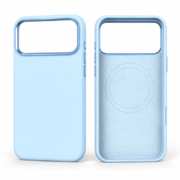
Silicone phone cases are selected mainly for their soft-touch surface, comfortable grip and strong color presentation. Liquid silicone rubber is a moldable elastomer, and commercial grades can be formulated across different hardness and color requirements. The finished case is solid and cured; “liquid silicone” describes the material and processing route, not the state of the final product.
Lumei’s listed liquid silicone models use a microfiber lining, and magnetic versions are available. This is a useful reminder that the visible silicone surface is only one part of the product. Depending on the design, a supporting inner shell or insert may also be present. Buyers should confirm the cross-section instead of assuming that every silicone-labelled case is made from one homogeneous material.
Why buyers choose silicone
- A smooth, soft-touch surface can support a premium and minimalist product position.
- Solid custom colors can be central to a seasonal, fashion or brand-matched collection.
- Logo, magnetic structure and custom packaging options are available for suitable projects.
- A microfiber lining can help separate the phone back from harder internal surfaces.
What to check
Evaluate coating or surface consistency, color matching, dust and lint attraction, edge coverage, button feel, camera opening, lining adhesion and any internal support. Repeatedly install and remove the sample to check whether the edge stays fitted. If a magnetic ring is included, test alignment and charging with the actual device and intended accessory.
PU Leather Phone Cases
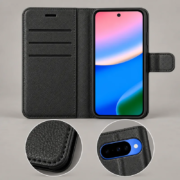
In this category, PU normally means polyurethane-based synthetic leather, not TPU. The PU layer provides the leather-like surface and grain, while another material usually supplies the shape and phone-holding function. A current Lumei leather case specifies a PU leather surface with a TPU frame, and the listed flip-wallet design uses a soft TPU holder.
PU leather is useful when the collection needs a business, gift, fashion or wallet direction. It can support different grains, colors, printed patterns, logos and embossed branding. Wallet and folio structures can also add card slots, a cash compartment or a viewing stand.
Why buyers choose PU leather
- Leather-like texture creates a different visual category from clear or molded plastic cases.
- Wallet and folio layouts can combine phone protection with card storage and stand functions.
- The surface can support color, printed artwork, logos and embossing, subject to the selected PU construction.
- PU can be combined with a flexible TPU holder or a more rigid supporting shell.
What to check
Confirm whether the quoted material is PU leather, genuine leather or another coated textile; these terms must not be used interchangeably. Inspect grain consistency, color, surface feel, edge paint or wrapping, stitching, fold endurance, card-slot dimensions, adhesive areas and the material of the inner phone holder. For embossed logos, approve depth, edge definition, position and visibility on the chosen grain.
TPU + PC Phone Cases
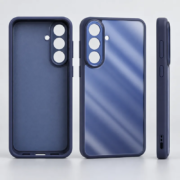
TPU + PC cases combine thermoplastic polyurethane with polycarbonate. The TPU commonly forms the flexible frame, bumper or shock-absorbing edge, while the PC forms a more rigid back panel, shell or decorative component. Polycarbonate grades are widely used where stiffness and impact performance are important, but the final case still depends on wall thickness, shape and assembly.
This hybrid structure gives designers clear functional zones. The edge can flex around the phone, while the rigid component can support a flat transparent back, printed panel, magnetic ring, stand or stronger shape definition. Lumei’s magnetic double-layer case is an example of a feature-led TPU + PC product.
Why buyers choose TPU + PC
- Flexible and rigid components can be assigned different jobs within one design.
- A rigid back can create a stable area for artwork, transparency or functional hardware.
- UV, heat-transfer and silk-screen decoration can be considered for suitable surfaces.
- Magnetic rings and custom packaging are available for suitable projects.
What to check
Inspect the joint between the TPU and PC components, especially around corners, camera openings and any detachable sections. Check the hard panel for scratches, stress marks and print adhesion. Confirm whether the parts are co-molded, bonded or mechanically assembled, because the construction can affect appearance, durability and cost. Magnetic alignment must be tested on the complete assembled sample.
TPU vs Silicone: What Is the Difference?
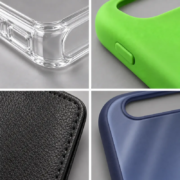
The keyword “TPU vs silicone” often suggests that one must defeat the other. For product development, the more useful answer is that they create different customer experiences. TPU is normally chosen for structural versatility and decoration flexibility. Silicone is normally chosen for its soft-touch, grippy surface and premium solid-color appearance.
| Decision factor | TPU | Silicone |
|---|---|---|
| Typical feel | Flexible; finish can range from clear and glossy to matte or textured | Soft-touch, smooth and usually more grippy |
| Visual direction | Clear, translucent, printed, glitter, patterned or solid color | Clean solid colors and minimalist premium styling |
| Structure | Can form a complete flexible case or a bumper in a hybrid case | Often used as the exterior; lining or internal support may be added |
| Decoration | UV, heat transfer, silk screen and other methods may be available | Logo and color customization are common; the exact method depends on the surface |
| Buyer checks | Grade, clarity, yellowing expectations, fit and surface wear | Surface consistency, lint attraction, lining, edge retention and color |
If the range needs transparent or complex printed designs, TPU is often the more direct starting point. If the range is built around a soft hand feel and controlled solid colors, silicone is often the stronger starting point. Request samples whenever the feel of the product is part of the selling proposition.
Which Is the Best Phone Case Material for Your Product Line?
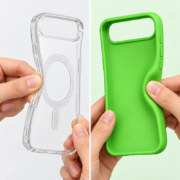
There is no universal best phone case material. The best choice is the one that supports the product promise and can be produced consistently at the required price, quantity and quality level.
| Product goal | Recommended starting point | Why |
|---|---|---|
| Flexible entry-level or broad-model range | TPU | Versatile structures and finishes; suitable for many printed, clear and magnetic concepts |
| Premium soft-touch solid-color collection | Silicone | Distinct hand feel and strong color-led presentation |
| Wallet, folio, business or gift range | PU leather | Leather-like surface plus card, stand and embossing options |
| Rigid-back, magnetic or feature-led protective design | TPU + PC | Flexible perimeter and rigid component can support different functions |
| Transparent design | Clear TPU or TPU + clear PC | Choose after comparing clarity, scratch behavior, edge feel and appearance expectations |
| Artwork-heavy collection | TPU or TPU + PC | Provides several printable surfaces and process options, subject to sample testing |
How Material Choice Affects Customization
Customization should be evaluated on the complete case, because the same process does not behave identically on every surface. Artwork size, ink system, texture, curvature, coating, magnetic parts and packaging all influence the production route.
| Material / structure | Confirmed customization options |
|---|---|
| TPU | UV artwork, heat transfer, silk-screen logo, custom color, magnetic structure and custom packaging |
| Silicone | Custom color, logo, magnetic structure and custom packaging |
| PU leather | Custom color, logo, printed pattern, embossed logo, magnetic structure and custom packaging |
| TPU + PC | UV artwork, heat transfer, silk-screen logo, magnetic structure and custom packaging |
These are capability categories, not a promise that every process works on every SKU. Final feasibility and MOQ should be confirmed after reviewing the phone model, case structure, material surface, artwork, print position, color, quantity and packaging design.
What Should a Brand Buyer Check in Material Samples?
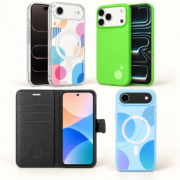
A material swatch is useful, but it cannot replace a complete fitted sample. The final product combines material behavior with geometry, tooling, assembly and decoration. Use the same device model and the same test routine when comparing suppliers.
- Material identity and complete layer structure, including the inner holder, lining, rigid panel and magnetic parts.
- Fit around every edge, port, speaker opening, camera opening and button.
- Surface feel, gloss or matte level, grain, transparency and color consistency under neutral light.
- Flexibility and shape recovery without overstretching the sample beyond normal use.
- Layer bonding, edge finishing, seams, wrapped corners, adhesive areas and detachable components.
- Logo or artwork color, registration, adhesion, edge definition and position.
- Magnetic alignment and charging performance with the actual phone and intended accessory.
- Packaging fit, product protection, barcode location and required warning or compliance information.
Record approved details with photographs and a written specification. A verbal description such as “same quality as the sample” is not precise enough for repeat orders.
How to Request an Accurate Material Recommendation
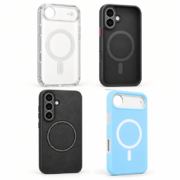
A useful quotation request gives the supplier enough information to recommend a structure, not just a price. Send:
- Target phone models and quantity by model.
- Target customer group, retail price range and sales channel.
- Preferred material or the desired feel, appearance and function if the material is not yet decided.
- Stock color or custom color requirements, including Pantone references when available.
- Logo or artwork files, print position and preferred decoration method if known.
- Magnetic charging, card storage, stand, clear back, soft-touch or other structural requirements.
- Retail packaging, inner packaging, barcode and labeling requirements.
- Destination country and target delivery date.
Lumei can review these requirements and coordinate with suitable manufacturing partners for sampling, production, quality inspection and shipping. MOQ and lead time are confirmed according to the selected product and customization plan.
Frequently Asked Questions
What is the best material for a phone case?
There is no single best material for every product. TPU is a versatile flexible option; silicone is strong for soft-touch solid-color designs; PU leather suits wallet and business styling; and TPU + PC suits designs that combine a flexible edge with a rigid component.
Is TPU better than silicone for phone cases?
TPU is not automatically better. It is often more suitable for clear, printed or structurally varied designs. Silicone is often more suitable when soft touch, grip and solid-color presentation are the priorities.
Are silicone phone cases made only from silicone?
Not always. Some use a silicone exterior with a microfiber lining, supporting shell, magnetic ring or other components. Confirm the complete cross-section with the supplier.
Is PU leather the same as genuine leather?
No. PU leather is a polyurethane-based synthetic leather material. Product pages and quotations should identify PU leather and genuine leather accurately rather than using the terms interchangeably.
What is a TPU + PC phone case?
It is a hybrid case that uses flexible TPU and rigid polycarbonate in different parts. A common arrangement is a TPU frame with a PC back or supporting shell.
Can all four material types include magnetic charging structures?
Yes, magnetic versions can be developed across TPU, silicone, PU leather and TPU + PC categories, but the ring position, internal construction and charging performance must be checked on the final sample.
Can logos and artwork be applied to every phone case material?
Customization is available, but the suitable method depends on the exact surface and case structure. UV artwork, heat transfer, silk screen, embossing and other methods should be confirmed through artwork review and sampling.
What material information should be written in a purchase order?
List the material of each main component, approved color and finish, lining or inner-shell material, magnetic structure, artwork method, packaging and the approved sample reference.
Should I approve a material swatch or a finished case sample?
Use both when necessary, but approve a finished fitted case before mass production. A swatch cannot demonstrate fit, button response, edge retention, layer bonding, magnetic alignment or final decoration.
What is the MOQ for custom phone case materials?
MOQ depends on the selected product, phone model, material, color, decoration method and packaging. Selected in-stock cases may start from 50 units, while custom processes may have separate minimums. Confirm the final MOQ during quotation.
Choose the Right Phone Case Material for Your Brand
Material selection should translate a product idea into a repeatable specification. Define the desired feel, appearance, protection concept, features, price level and decoration first. Then compare complete samples made with the proposed structure.
Lumei supplies in-stock and customized phone case options and works with specialized manufacturing partners according to the model, material, process, quantity and delivery requirements. Share your project details to receive a tailored material recommendation, MOQ assessment and quotation.
